
EVV + Scheduling + Billing: Why Connected Systems Are the Future of Home Care
Published on April 10, 2026 by Anna from Aaniie
In home care, the work that matters most happens in the home.
It’s the conversations at the kitchen table, the reassurance in a familiar voice, and the confidence that comes from a caregiver showing up when they’re expected.
Behind every one of those moments is a network of operational decisions. Schedules need to align, visits need to be verified, care needs to be documented, payroll needs to run, and billing needs to reflect what actually happened in the home.
None of this is visible to the client or their family, but each thread plays a role in shaping the entire care experience.
As agencies grow, the volume of this activity increases. More visits, more caregivers, more coordination, and the potential for more data moving between systems.
The question isn’t whether these workflows can be managed more effectively – they can – but how best to connect them.
Because when EVV, scheduling, and billing operate as part of a synchronized ecosystem in harmony (as with Aaniie Care’s EVV-compliant home care software), something changes. Not only in efficiency, but in how the entire agency functions.
Compare the best home care software providers in 2026
Find out why Aaniie Care was ranked #1 →
The operational backbone of home care
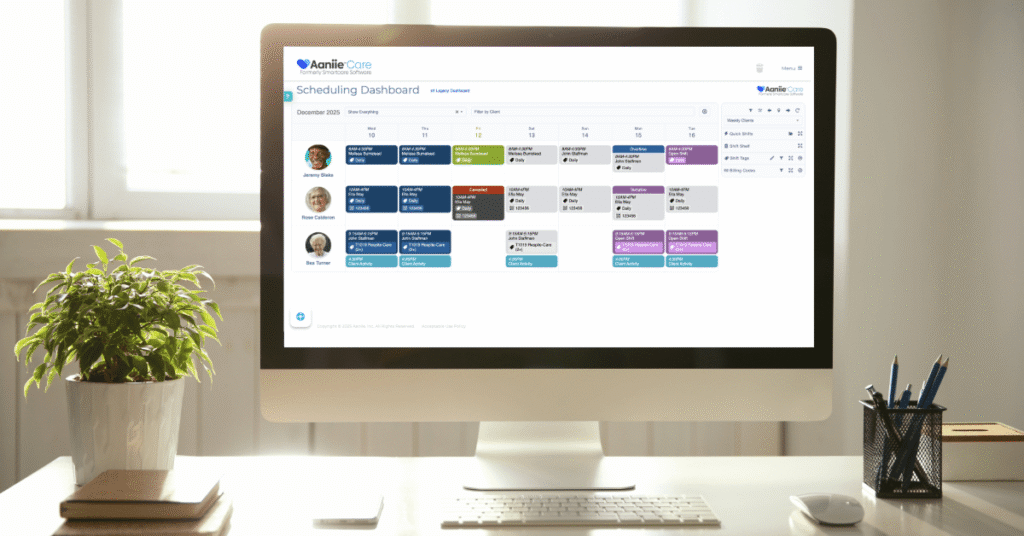
Every home care agency, regardless of size, depends on a set of core workflows. For instance:
- Scheduling ensures that care is planned → and that the right caregiver is assigned to the right client at the right time.
- EVV captures required visit data → including time, location, and service details, and transmits it to state EVV aggregators to support Medicaid compliance and reimbursement.
- Billing and payroll close the loop → translating care into revenue for the agency and pay for the caregiver.
Individually, each of these functions is essential, but they don’t need to unfold in three separate workstreams. With all-in-one home care software like Aaniie Care, they function as parts of a unified, continuous chain.
When that chain is connected within one environment, agencies operate with greater clarity. The opportunity is not just to perform each function well, but to empower them to inform and reinforce one another.
From tasks to flow: What changes when systems are connected

In a connected environment, work stops behaving like isolated tasks and begins to operate as a flow.
Imagine a caregiver clocks in using Aaniie Care. That action doesn’t just record attendance: it updates the schedule, confirms service delivery, and creates a verified data point that carries forward through the system and onward to the state EVV aggregator.
As the visit progresses and concludes, that same data becomes the foundation for payroll and billing. The system reflects what actually happened – in real time – and securely transmits that data to the appropriate state aggregator, to support compliance and reimbursement.
For administrative teams, this changes the nature of the work; instead of reconciling information across systems, they are reviewing and validating a single, continuous record.
And, for caregivers, it means less friction – fewer steps, fewer uncertainties, and a clearer sense that the systems they use are supporting them, rather than slowing them down.
Operational strength that supports growth
Growth in home care is a positive signal, but it does bring with it an increase in complexity. More clients require more precise scheduling, more caregivers require more coordination, and more visits require greater visibility.
A unified home care software provides the structure needed to support that growth. Practically, that means schedulers can focus on making better matches, admin teams can rely on better-aligned data, and leaders gain real-time visibility into operations.
In other words, what emerges is stability. That stability is what allows agencies to grow without losing control of the details that matter.
Financial workflows that reflect reality

In home care, financial accuracy is closely tied to operational accuracy. Visits that are not recorded accurately – and properly submitted to the appropriate state EVV aggregator – may not meet compliance requirements, and are therefore unlikely to be reimbursed.
But when EVV, scheduling, and billing are connected, alignment occurs naturally.
Verified visits flow directly into payroll, billing is generated from actual service delivery, and claims move forward with fewer delays or adjustments.
The result is a financial process that reflects reality. Agencies often see the impact of this quickly:
- Billing workloads reduced by up to 80%
- Payroll processing reduced from hours to minutes
- Back-office efficiency improved by up to 60%
- EVV compliance supports timely Medicaid reimbursement
But beyond the numbers, there is a broader benefit in newfound confidence.
Confidence that what is being billed is accurate, that caregivers are being paid correctly, and that revenue will arrive as expected.
Beyond EVV: Why connection matters more than compliance alone

On its own, EVV is only one piece of a much larger operational picture. Some systems in the market tend to focus narrowly on EVV-related requirements, offering basic tools to capture visits and support billing.
Aaniie Care approaches it differently.
Instead of treating EVV as a standalone function, it embeds it within a broader ecosystem designed to support the entire agency.
That includes:
- Intelligent Client/Caregiver Matching to improve fit and continuity
- A Mobile Caregiver App that keeps teams connected in real time
- Enterprise-level KPI Dashboards that surface performance and trends
- Built-in hiring, engagement, and rewards tools to support retention
- A Family Portal that strengthens transparency and trust
The result is a concerted coordination – encompassing EVV, yes, but simultaneously extending across every part of the business. Speaking about the versatility and 360° utility of Aaniie, Randy Rhames – owner of QwestCare Home Health – had this to say:
“I’ve saved so much time in billing and scheduling. I can set up bulk scheduling, which is so much easier. Before, it took me 4 or 5 hours a week just to schedule. Aaniie is saving me at least 15-18 hours a week on billing and scheduling. Aaniie has given me my weekends back.”
– Randy Rhames, Owner, QwestCare Home Health
Alignment across the entire agency
When systems are connected, alignment becomes part of daily operations. Information flows between teams without friction; caregivers, administrators, and leadership operate from the same source of truth; and decisions are informed by real-time visibility.
This alignment has a compounding effect:
- Care delivery becomes more consistent.
- Communication becomes clearer.
- Operations become more predictable.
Over time, those gains build into something much more profound. The result is a more stable, more responsive, and more capable agency.
The future of home care is connected

Part of what changes with a home care software like Aaniie Care is how EVV, scheduling, and billing dovetail and how they work together in harmony.
As we move forward, the future of the home care industry won’t be defined by adding more tools or by layering more systems on top of one another, but by connection.
By workflows that operate as one.
By data that moves without friction.
By systems that support the people using them.
When that connection is in place and embedded, agencies gain more than efficiency. They gain clarity, control, and they create the conditions for better care – delivered consistently, at scale.
Everything you need is All-in-Aaniie.
Bring EVV, scheduling, billing, and your entire agency operation into one connected ecosystem with Aaniie Care.
Request a free demo or talk to our team today
