
How Can Your Home Care Agency Compete for More Quality Caregivers?
Published on April 30, 2026 by Anna from Aaniie
The home care industry is growing – and so is the demand for skilled, reliable, compassionate caregivers.
At the same time, caregivers today have more choices than ever before. Not just in terms of where they work, but also in how they work, what they expect, and what they value in an employer.
In reality, most agencies look similar on the surface: comparable pay, similar benefits, similar workloads. So how do you stand out?
The agencies attracting and retaining the strongest caregivers don’t simply compete on compensation. They differentiate themselves through the experience they create for their teams – every day, across every interaction.
Because competing in today’s labor market isn’t about reacting to shortages. It’s about building a more connected, supportive, and engaging environment – one that caregivers actively choose.
The Retention Reset: Building a Sustainable, Caregiver-First Home Care Agency
Read Now →
The reality of today’s caregiver market
Demand for caregivers is on the rise, creating more opportunities across the industry.
- The U.S. home care market is projected to continue its growth, driven by an aging population and a strong preference for care delivered at home.
- At the same time, the industry is expected to require an additional 1.2 million care workers by 2030.
- Retention remains a challenge. Turnover rates in home care often exceed 70%, creating constant pressure on recruitment and operations.
Expectations are evolving alongside this. In this day and age, caregivers evaluate roles based on more than pay alone. They’re looking at:
- Flexibility and control over their schedules
- Clear, consistent communication
- Manageable workloads
- Recognition, fulfillment, and appreciation
- Access to earnings and financial flexibility
In other words, agencies aren’t just competing to “hire” caregivers. They’re competing to offer a better overall working environment.
Those that understand what caregivers really value – and reflect that in how they operate – are the ones best positioned to attract and, crucially, retain top talent.
Standing out in a sea of similar agencies
When many agencies offer similar roles and similar compensation, differentiation becomes essential.
Increasingly, that differentiation comes from the “extras” – the additional experiences, tools, and benefits that make working at one agency feel meaningfully better than working at another.
These are more than superficial perks. They actively shape how caregivers perceive your agency, from the very first interaction:
- What stands out in a job posting
- How engaging the hiring process feels
- Whether the role continues to feel rewarding, over time
From recognition programs to financial flexibility and better day-to-day tools, these elements create a stronger, more compelling caregiver experience. That experience is what sets leading agencies apart.
Retention is the real competitive advantage
Recruitment may bring caregivers in, but retention is what sustains growth. The most effective way to compete for talent is to create an environment that caregivers don’t want to leave.
Because when caregivers stay with your agency:
- Continuity of care improves
- Relationships with clients deepen
- Teams become more stable
- Operational pressure decreases
And, more importantly, high rates of retention strengthen your reputation as an employer.
So… what does all this look like in practice?
The agencies that consistently attract and retain top talent are the ones focusing on everyday elements that shape how work actually feels. Below, we explore seven proven strategies to help you create an environment that will help you compete for more quality caregivers in a challenging market.
1. Implement scheduling that supports flexibility and control

Flexibility has become one of the most important factors in caregiver satisfaction and retention. Rigid or difficult-to-manage schedules can quickly create friction – especially in a role that already demands high levels of adaptability.
With dynamic scheduling tools in place, agencies can create a more responsive and supportive experience:
- Caregivers gain clearer visibility into their schedules
- Changes can be managed quickly and efficiently
- Mobile access allows updates from anywhere
This kind of flexibility gives caregivers a greater sense of control over their time.
And that control makes a difference – it reduces stress, supports work/life balance, and contributes to a more sustainable, satisfying role.
2. Match clients and caregivers intelligently to create more meaningful experiences

For many caregivers, job satisfaction is closely tied to the relationships they build with clients. When those relationships feel natural and well-matched, the work itself is more rewarding. Naturally, this will lead to increased retention as well.
With smart Client/Caregiver Matching, agencies can intelligently align:
- Skills and care needs
- Availability and scheduling preferences
- Personality and communication style
The result? Stronger care continuity and better-fit placements for both client and caregiver retention.
Over time, these consistent, well-matched relationships create a more meaningful experience for both caregivers and clients – one where trust develops more easily, and care feels more personal.
3. Keep caregivers connected through streamlined, fluid communication
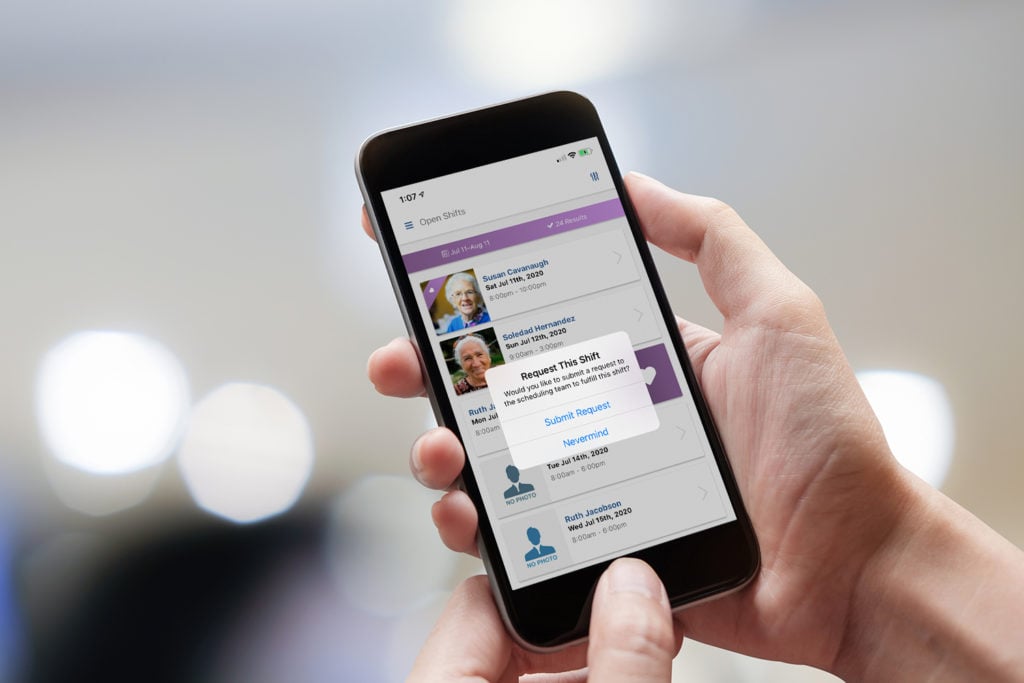
Caregivers may often work independently. But they shouldn’t feel disconnected.
When communication is inconsistent or difficult to access, frustration can build quickly. Small gaps in information can turn into larger issues over time.
However, with unified and embedded communication tools such as a dedicated Caregiver app, agencies can create a more connected environment:
- Updates are shared in real time
- Care details are easy to access
- Teams stay aligned without needing to chase information
This consistency helps caregivers feel informed, supported, and part of a wider team, even while they’re working in the field. And, in turn, that sense of connection plays a central role in both engagement and retention.
4. Reduce administrative burden in the field

Caregivers want to focus on delivering care, not navigating complex software systems or repetitive administrative tasks.
Even small inefficiencies in documentation or workflows can add up over time, creating unnecessary friction in the day-to-day experience. With caregiver-focused tools:
- Schedules and care plans are accessible on mobile
- Documentation workflows are guided and intuitive
- Administrative steps are simplified
This reduces the time and effort required to complete routine tasks, allowing caregivers to focus more of their energy on the people they support.
5. Recognize, reward, differentiate

Feeling valued is one of the most powerful drivers of retention. It’s also a key differentiator in recruitment.
Agencies that visibly recognize and reward their caregivers create an environment where people feel seen, appreciated, and motivated to stay, right from day one.
With tools like Caregiver Rewards, agencies can:
- Highlight incentives in job postings to attract attention
- Introduce reward systems early in the hiring process to build engagement
- Offer longer-term incentives that encourage ongoing participation
Speaking about the impact Aaniie Care’s Caregiver Rewards had on operations, Bob Swadkins (owner, Golden Heart Summerlin) had this to say:
“I saw right away that the feature was exactly what we needed – the ability to reward caregivers. Our caregivers enjoy it. It differentiates us. I think that’s the biggest thing.”
– Bob Swadkins (owner, Golden Heart Summerlin)
Some agencies go beyond ‘standard’ rewards, offering higher-value incentives (such as TVs or even cruises) that create excitement and reinforce long-term commitment. Continuing his appraisal of the partnership with Aaniie, Swadkins notes:
“I’ve talked to all the competitors, and none of them are doing this kind of thing. They give a gift card here and there, but it’s not an organized effort. With Caregiver Rewards, there are automatic triggers, and caregivers know they earn points and see what they can do with the points.”
Aside from improving morale considerably, efforts like these show that your agency cares and helps you to stand out in the crowded labor market.
6. Make financial flexibility a competitive edge

Access to earnings is becoming an increasingly important factor for caregivers. Many expect a significant degree of flexibility in how and when they’re paid.
Offering options like Same-Day Pay, through integrated partners and vendors, can make a meaningful difference:
- Caregivers gain faster access to their income
- Financial stress is reduced
- Greater control over personal finances is created
Even at a high level, offering or enabling this kind of flexibility signals that your agency understands modern workforce expectations. That understanding builds trust from the very beginning.
7. Give leaders the visibility required to support teams

At the leadership level, supporting caregivers effectively requires 360° visibility into what’s happening across your organization. Without it, challenges like workload imbalances or disengagement can go unnoticed until they become more difficult to address.
With caregiver/client surveys and real-time KPI dashboards to insights:
- Leaders can identify trends early
- Workload distribution becomes clearer
- Opportunities for support can be addressed proactively
This allows agencies to take a more responsive, supportive approach to workforce management. And, when caregivers feel supported, they’re far more likely to stay with your agency long-term.
Make caregiver experience a recruitment advantage
Importantly, a strong caregiver experience doesn’t just improve retention. It strengthens recruitment as well.
This is because satisfied caregivers are more likely to:
- Refer others to your agency
- Speak positively about their experience
- Contribute to a stronger employer reputation
As retention improves, recruitment becomes more efficient and more sustainable. In this way, experience becomes a competitive advantage that compounds over time.
Compete through experience, not just compensation
Forward-thinking agencies are already changing how they approach the labor market. They’re moving from:
- Reactive hiring → proactive workforce strategy
- Filling shifts → building stable, engaged teams
- Managing tasks → supporting people
The difference lies in how caregivers experience their work each day, shaped by scheduling, communication, recognition, and support. That is what ultimately determines whether caregivers choose to join, and whether they choose to stay.
Build an environment caregivers choose
Competing in today’s labor market isn’t about offering more. It’s about offering a better experience.
When scheduling, communication, engagement, and operations work together in harmony, as part of the same unified home care software:
- Caregivers feel more supported
- Teams become more stable
- Care delivery becomes more consistent
With an all-in-one platform like Aaniie Care, agencies can strengthen the caregiver experience at every touchpoint, from recruitment right through to long-term retention.
The result is a synchronized, smooth, and fulfilling working environment that caregivers choose – and continue to choose in the long run.
Create a caregiver experience that attracts, engages, and retains top talent with Aaniie Care.
Request a free demo or talk to our team today
