
Unlocking Hidden Capacity in Home Care: 5 Smart Ways to Do More With the Team You Already Have
Published on May 28, 2026 by Anna from Aaniie
For the modern home care agency, demand is growing, caregiver shortages remain a challenge, and expectations around responsiveness and quality continue to rise.
At first glance, growth can seem to require one thing above all else: more people.
But – increasingly – agencies are discovering something important: they already have more operational capacity than they realize. The challenge is uncovering it.
This is not about asking caregivers or office teams to work harder. Nor is it about creating additional pressure inside already demanding environments.
Rather, it’s about removing friction. Reducing wasted time. Improving visibility. Helping teams coordinate more smoothly and make better day-to-day decisions.
This is why forward-thinking agencies are focusing less on simply adding headcount and more on unlocking the capacity already inside their operations. With connected workflows, KPI dashboards, and embedded operational intelligence tools like Aaniie Intelligence helping surface patterns agencies might otherwise miss, smarter coordination becomes a major driver of sustainable growth.
Want to uncover hidden capacity inside your agency?
See how Aaniie Care helps home care teams improve visibility, coordination, and day-to-day efficiency.
Hidden capacity often exists inside everyday operations
Operational strain is not always caused by a lack of people.
More often, it can emerge through disconnected workflows, communication lag, duplicated admin work, scheduling inefficiencies, and limited operational visibility.
A missed update here. A scheduling delay there. Manual reconciliation between systems. Repeated caregiver questions. Small operational interruptions – that may only take a few minutes each – but that happen hundreds of times across the week.
One agency recently described that they receive 400-700 caregiver texts per day, before centralizing communication workflows through Aaniie Care, which improved the situation considerably. What this revealed was not a communication issue, but a visibility and coordination issue; one that quietly consumed enormous operational bandwidth.
Another agency – All About You Health Services, based in Massachusetts – explained how Aaniie helped improve operational efficiency in a post-pandemic world.
“The software has eliminated so many redundancies that we had in our process and our flow […] we’ve streamlined everything from hiring to retention to patient documentation. And it’s all just one platform.”
– Katie Ortell, CEO-Owner
This speaks to where hidden capacity is often lost: in fragmented workflows, reactive coordination, and operational friction that slowly drains time and attention from teams.
The good news? Much of that capacity can often be recovered. Here are 5 Smart Ways to Do More With the Team You Already Have:
1. Reduce scheduling friction and unused gaps
Why scheduling inefficiencies add up quickly
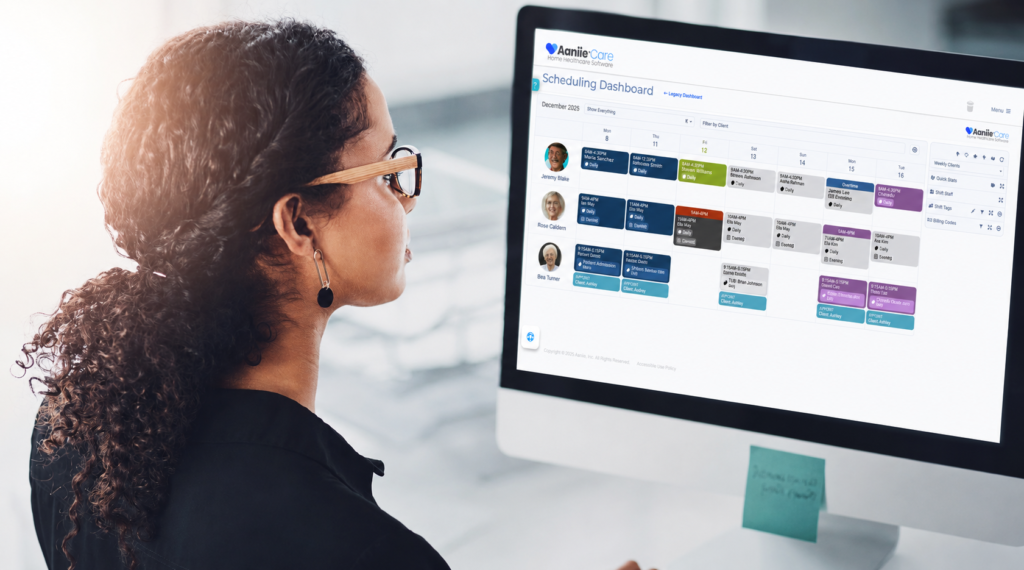
Scheduling is the heart and soul of home care operations – so even relatively small inefficiencies can create ripple effects across staffing, caregiver satisfaction, and client experiences.
Open shifts, travel inefficiencies, underutilized caregiver availability, and last-minute coordination all create operational drag over time. When schedulers are forced to manage these challenges manually, pressure can escalate.
What smarter scheduling unlocks
Connected and embedded scheduling tools help agencies operate with greater responsiveness and balance.
With dynamic scheduling, real-time visibility, and stronger caregiver-client matching, agencies can coordinate care more efficiently while reducing unnecessary strain on office teams and caregivers alike.
That can mean:
- Faster shift coordination
- Better use of caregiver availability
- More balanced workloads
- Reduced scheduling friction
- More consistent coverage
Importantly, the outcome is not “doing more work.” It’s creating smoother workflows that allow agencies to operate more effectively with the teams they already have.
2. Improve coordination across teams and care delivery
Communication gaps slow operations down…
Home care entails continuous coordination between caregivers, schedulers, office teams, clients, and families.
When communication becomes fragmented, operational efficiency can suffer. Updates might be missed, questions repeated, or teams spend time chasing information instead of acting on it.
Even small communication delays can create larger operational slowdowns across the day.
… while connected communication creates smoother workflows
Unified communication tools help agencies centralize updates, improve visibility, and reduce unnecessary interruptions.
When caregivers can access schedules, updates, care information, and communication tools in one place – and, crucially, with mobile functionality, such as in a Caregiver App – coordination becomes significantly smoother. This means:
- Faster information flow
- Fewer repeated questions
- Less manual follow-up
- Better alignment across teams
- A more connected care experience overall
Operationally, that translates into reduced friction and more time spent supporting care delivery.
3. Reduce administrative burden that consumes valuable time

Small admin tasks quietly create operational strain
Administrative inefficiencies rarely appear dramatic when considered in isolation.
Things like manual data entry, repeated documentation, or cross-checking information between systems. Individually, each seems relatively minor; collectively, they can absorb considerable amounts of operational capacity.
Connected systems help information flow more naturally
When scheduling, EVV, billing, payroll, and documentation work together inside one connected ecosystem, information flows more naturally across an organization.
Instead of repeatedly entering or reconciling the same information, teams can operate from a more unified operational foundation.
That creates:
- Less duplicate work
- Fewer reconciliation issues
- Reduced manual coordination
- Faster administrative workflows
- More operational consistency
As a result, teams spend less time managing systems and more time focused on supporting caregivers and clients.
4. Use operational visibility to make faster, smarter decisions
Many operational problems develop gradually
Similarly, operational challenges don’t emerge all at once.
Overtime trends, workload imbalance, attendance issues, scheduling strain, and billing slowdowns typically develop gradually over time. Without clear visibility, these patterns can remain hidden until they become much more disruptive.
KPI dashboards support more proactive operations
However, real-time business intelligence and KPI dashboards help agencies identify trends earlier and respond more proactively. Leadership teams gain clearer visibility into things like:
- Workforce trends
- Staffing patterns
- Revenue and billing activity
- Scheduling strain
- Operational performance indicators
AI-supported operational intelligence tools (like Aaniie Intelligence) can also help surface patterns agencies might otherwise miss – helping leaders prioritize attention more effectively.
The result? Faster decision-making, clearer priorities, and more proactive day-to-day operations.
5. Support caregivers more effectively to improve stability

Capacity and caregiver experience are closely connected
Caregiver experience has a direct impact on operational stability.
The potential for burnout, communication friction, scheduling instability, overtime pressure, or administrative frustration could all contribute to retention challenges over time.
And when retention suffers, operational strain increases even further.
Better operational support creates stronger teams
This is where “doing more with less” requires some careful framing.
Because it should never mean asking caregivers to absorb more pressure.
Instead, it means reducing unnecessary operational friction so caregivers can focus their energy where it matters most: delivering quality care.
In real-world terms, this looks like more balanced workloads, clearer communication, easier workflows, and faster access to information – all of which help create a more sustainable work environment.
Truly proactive agencies also use tools like Caregiver Rewards to reinforce positive performance behaviors, such as punctuality, picking up difficult shifts, or delivering strong client experiences.
Over time, these operational improvements contribute to:
- Stronger caregiver retention
- Better continuity of care
- Improved workforce stability
- More sustainable agency growth
Unlock the capacity already inside your agency
Small improvements compound over time.
Better scheduling. Smarter communication. Reduced administrative burden. Stronger operational visibility. More proactive leadership.
Put together, these improvements help agencies unlock the unutilized capacity that already exists inside the business. In isolation, each one appears to be a marginal gain; but when those gains are stacked together, the margin widens significantly.
With connected workflows, operational intelligence, and truly unified home care software like Aaniie Care, agencies operate more efficiently, support caregivers more effectively, and grow with greater confidence – all without creating unnecessary strain on the people delivering care day-in, day-out.
