
The Forgotten Middle: Unlocking a Growing Opportunity in Senior Care
Published on June 5, 2026 by Anna from Aaniie
As America’s senior population continues to grow and diversify, care providers are being challenged to meet the increasingly complex needs of aging adults. From solo agers and seniors with multiple chronic conditions to those requiring specialized dementia support, today’s care landscape is far from one-size-fits-all.
Among these growing demographics is one group that has remained largely overlooked by traditional care models despite representing a sizable segment of the market: the ‘Forgotten Middle.’
By 2029, this group of seniors is projected to reach 14.4 million in the US, many of whom will require assistance with daily living, chronic condition management, mobility limitations, and aging safely at home.
For home care agencies, senior living communities, and other aging care providers, the ‘Forgotten Middle’ presents both a significant challenge and a major opportunity.
In this article, we explore who the ‘Forgotten Middle’ are, the unique challenges they face, and how senior care providers can develop innovative care models to better support this currently underserved population while unlocking opportunities for sustainable growth.
Who is the ‘Forgotten Middle’ in senior care?
In the context of long-term care, the ‘Forgotten Middle’ refers to middle-income seniors who have too many financial resources to qualify for state-funded programs like Medicaid, but who don’t have the means to comfortably afford private-pay care services.
While many may own a home or have retirement savings, they often lack the cash flow needed to sustain the rising costs of home care, assisted living, or long-term healthcare support. As care needs increase, many are forced to draw heavily on savings or home equity, ultimately facing the difficult decision of selling their home to fund care.
Most of these older adults – typically aged 75 and older – require some level of ongoing assistance with things like daily living activities (ADLs), but not necessarily full-time or intensive care in the early stages.
For senior care providers, this is an important distinction. These seniors aren’t necessarily looking for around-the-clock care or luxury services. In many cases, they simply need practical, flexible support that helps them remain safe, independent, and healthy as they age in their own homes.
However, the traditional senior care market has historically struggled to meet the needs of the ‘Forgotten Middle’ because their financial profile doesn’t neatly fit existing care models.
What unique challenges do the ‘Forgotten Middle’ face?
The ‘Forgotten Middle’ faces a unique combination of financial, health, and caregiving challenges that traditional senior care models aren’t typically designed to address.
Many older adults in this demographic rely on fixed, moderate sources of retirement income, including pensions, personal savings, and home equity. While they may appear financially stable on paper, the reality is that the cost of care can quickly become unsustainable – particularly for those requiring increasing support over many years.
Some of the biggest challenges facing the ‘Forgotten Middle’ include:
- Living longer with chronic conditions: Many middle-income seniors are managing diabetes, heart disease, mobility limitations, or early cognitive decline, increasing the need for regular – but not necessarily full-time – support to help them age safely in place.
- Asset depletion: As care needs increase, these individuals are often forced to draw heavily on their savings, retirement funds, or home equity in order to continue receiving the care they need – gradually exhausting the assets they’ve spent a lifetime building.
- Heavy reliance on unpaid caregivers: When it becomes financially difficult to continue professional care, spouses and adult children are often left to fill care gaps, which can create emotional, physical, and financial strain for entire families.
- Limited middle-market care options: Traditional care models are often built around either state-funded care or full private-pay services, with contracts requiring a minimum number of hours, leaving relatively few affordable, adaptable solutions for seniors whose needs fall somewhere in between.
- The risk of delayed care: Without access to sustainable care options, many seniors in this group postpone seeking professional, preventive support until a health crisis, fall, hospitalization, or major decline forces more urgent intervention.
Together, these challenges highlight a growing need for more accessible and affordable care approaches that better align with the realities of middle-income seniors – while creating new opportunities for care providers looking to expand their services in ways that have positive community impact and long-term viability.
Support more families with technology that simplifies care coordination and service delivery.
Eight ways care providers can better support the ‘Forgotten Middle’
As the ‘Forgotten Middle’ demographic continues to grow into a market of over 14 million older adults, home care agencies that can adapt their service offerings to support aging in place more creatively and efficiently – while continuing to serve existing clients – will play an increasingly important role in the future of senior care.
The good news is that meeting the needs of the ‘Forgotten Middle’ does not require a complete overhaul of existing service models. In many cases, it’s a matter of expanding, adapting, or more effectively promoting services that senior care providers already offer to create more affordable, accessible pathways to care.
Some of the most effective approaches include:
1. Offer home safety assessments and fall prevention services

Falls remain one of the leading causes of injury, hospitalization, and loss of independence among older adults. By offering home safety evaluations, mobility support (including assistive devices), medication management, and fall prevention education, providers can help middle-income seniors identify and address potential risks before incidents occur.
These preventative services can be delivered at a relatively low cost while generating immediate value to a broader aging-in-place strategy. For middle-income older adults, avoiding a serious fall or hospitalization can significantly reduce future care expenses and delay the need for more intensive support, including a move into assisted living.
2. Provide ongoing wellness and safety monitoring
Many seniors in the ‘Forgotten Middle’ don’t require daily care but can benefit from regular wellness calls, brief in-home visits, medication reminders, and safety check-ins. These services provide ongoing oversight without the cost of extensive care schedules.
Incorporating remote monitoring tools and wearable technologies can further enhance this approach by helping to track activity levels, detect potential safety concerns, and provide additional peace of mind for seniors and their families between visits.
By identifying emerging concerns early – and monitoring seniors over time – providers can help prevent minor issues from developing into larger health crises. This personalized, proactive approach supports independence, improves outcomes, and creates a more affordable pathway to ongoing care – while strengthening continuous engagement between providers, seniors, and their families.
3. Create more flexible, ‘right-sized’ care packages
Not every senior requires large blocks of costly care time every week. Rethinking how care is structured and delivered to create more flexible options – that align with a client’s specific needs, preferences, and budget – can provide meaningful support while remaining financially manageable for seniors and their families.
This may include creating fewer, shorter visits, specific task-based options, or à la carte service offerings that allow middle-income seniors to select only the support they need – such as transportation assistance, meal preparation, medication reminders, companionship, grocery shopping, gardening, or post-hospitalization check-ins.
Many of these highly personalized services can be delivered effectively within existing care models, enabling providers to serve a broader range of clients, fill gaps within existing schedules, and establish relationships with seniors earlier in their care journey.
By tailoring services to individual needs and regularly reassessing care requirements, agencies can help more older adults access support earlier, maintain independence for longer, and avoid paying for services/time they may not yet require. For middle-income seniors, this creates a more affordable pathway to aging in place while ensuring care remains closely aligned with their needs over time.
4. Introduce more ‘as-needed’ support services

Many seniors in the ‘Forgotten Middle’ can benefit significantly from occasional support, at short notice, during periods of increased need – such as after a hospital stay, during a temporary illness, while recovering from an injury, or when family caregivers are unavailable.
By offering flexible, on-demand care services, home care agencies and senior living communities can provide much-needed practical support without requiring costly, long-term care commitments.
This allows middle-income seniors to access help when they need it most, extend their time living independently at home, and maintain greater control over their care budget. For providers, these services can create valuable opportunities to support clients whose needs fluctuate over time, strengthen continuity of care, and remain engaged with seniors who may later require more regular support.
5. Develop shared care and community-based models
In many areas, offering shared or coordinated services to multiple seniors living within the same community or geographic area can help providers expand access to care while creating more affordable options for the ‘Forgotten Middle.’
Shared care models include scheduled caregiver visits that serve multiple clients during a single trip, as well as wellness programs, group activities, educational sessions, and transportation support.
Providers may benefit from partnering with established NORC Supportive Service Programs (NORC-SSPs), which support Naturally Occurring Retirement Communities (NORCs) – neighborhoods, apartment buildings, or housing developments with high concentrations of older adults. These partnerships can be a more cost-effective way to connect seniors with the coordinated services, wellness resources, and aging-in-place support they need.
In addition to increasing access to care for middle-income seniors and reducing their individual care costs, shared care models can also help reduce operational costs for providers (including caregiver travel time and mileage), expand their reach, and strengthen local partnerships.
6. Connect seniors to a broader support network
Successful programs such as PACE (Programs of All-Inclusive Care for the Elderly) clearly demonstrate the value of coordinating healthcare, social services, transportation, and community-based care support around older adults. While seniors in the ‘Forgotten Middle’ don’t currently qualify for these CMS-funded programs, they provide a useful model for how a more coordinated and collaborative approach to care can reduce costs, improve outcomes, and help older adults remain independent for longer.
By building relationships with local nonprofits, healthcare organizations, day centers, meal-delivery programs, transportation providers, and community programs, agencies can help connect middle-income seniors to services that complement the care they’re already providing. This creates a more comprehensive support network without requiring seniors to pay for every need through private-pay services alone.
For home care providers, stepping into a more coordination-focused role can also be beneficial – improving client outcomes, strengthening family satisfaction, and reducing service gaps that may otherwise lead to preventable health crises.
It also positions agencies as valuable community partners and trusted advisors, helping strengthen referral partner relationships.
7. Support family caregivers more intentionally

For many middle-income seniors, unpaid family caregivers remain a critical part of their care journey. Spouses and adult children often provide significant day-to-day assistance to support aging in place while limiting care costs.
Rather than replacing family involvement entirely, home care providers can focus on better supporting and strengthening these existing caregiving networks. Services could include respite care, wellness visits, transportation assistance, medication reminders, overnight support, or help during particularly demanding periods of care.
By filling specific care gaps and providing professional oversight when needed, agencies can help reduce caregiver burnout while allowing families to remain actively involved in their loved one’s care.
Collaborative care models can create a more sustainable balance between professional and family support, helping seniors age in place for longer without placing excessive strain on caregivers or budgets. For providers, working more closely with families can strengthen trust, improve care coordination, and create longer-lasting client relationships built on partnership rather than dependency.
8. Provide financial transparency and predictability
For many seniors in the ‘Forgotten Middle,’ the challenge isn’t just the cost of care today, but the uncertainty around how those costs will change as their needs evolve. With limited financial flexibility and restricted access to state-funded programs, unpredictable or poorly defined pricing can quickly become a barrier to accessing ongoing care.
For home care providers and senior living operators, improving financial clarity is an important part of making services more accessible and sustainable for this demographic. When seniors and their families understand exactly what care will cost – and how it may need to be adjusted in the future – they’re more likely to engage earlier and make more confident long-term decisions.
This can include offering clearly structured pricing models that reflect different levels of care intensity or frequency, being transparent about additional services or add-on costs, clearly defining what’s included within standard packages, and helping families identify funding options they may not be aware of. It also involves helping families understand how care needs typically progress over time, and what that means in both practical and monetary terms.
By bringing greater structure and transparency to care planning and cost conversations, providers can reduce uncertainty, support earlier engagement, and help families plan for their loved one’s care in a more manageable way. For agencies, this approach reinforces their commitment to clients’ long-term well-being rather than just billable hours – supporting stronger retention, enhanced reputation, and consistent referrals.
As the ‘Forgotten Middle’ continues to grow, providers that can embrace more flexible and innovative approaches to care delivery and support will be better positioned to expand access to care, serve a broader client base, and create lasting opportunities for long-term growth.
But how can agencies deliver these more affordable and adaptable service models without overwhelming staff, sacrificing care quality, compromising operational performance, or reducing profitability?
Balancing affordability with operational sustainability
While these approaches can significantly improve access to home care for the ‘Forgotten Middle,’ implementing them successfully is not without challenges.
Whether incorporating shorter visits, flexible schedules, care coordination with external services, or family caregiver support – it’s inevitable that additional demands will be made on areas like scheduling, billing, communication, and workforce management.
Fortunately, providers don’t need to implement every strategy at once to make an impact. Many agencies begin by expanding or refining a single service area, gradually introducing new offerings as demand grows and operational processes mature.
Regardless of which strategies agencies adopt, success ultimately depends on having the right operational foundation in place to deliver more affordable long-term care efficiently, consistently, and profitably.
This is where having the right technology can make all the difference.
Turning innovative care models into operational reality
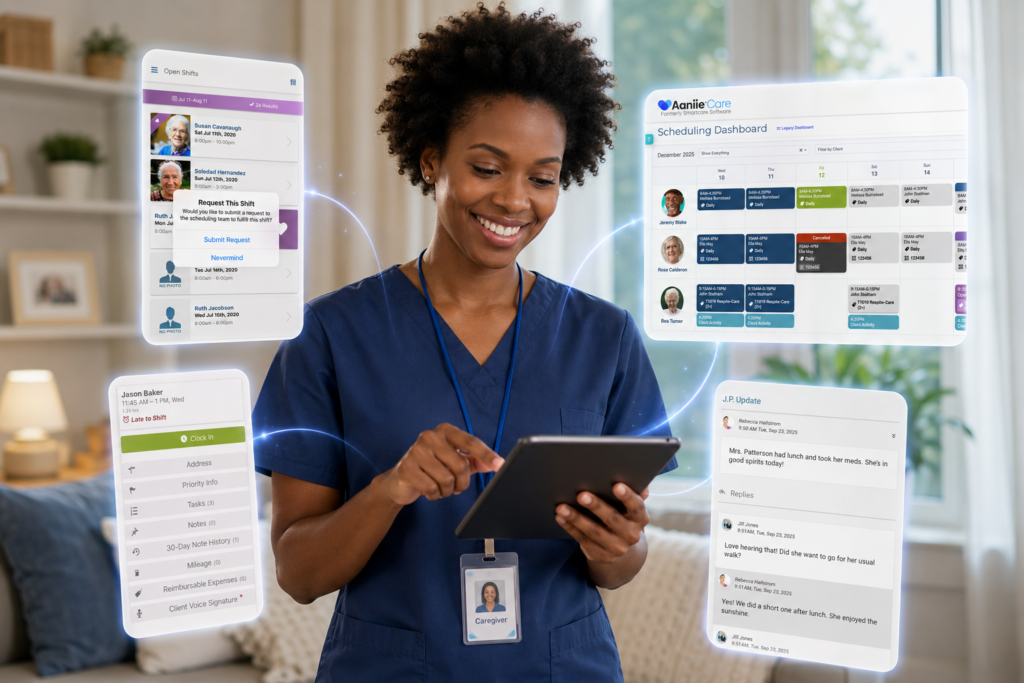
An all-in-one home care management platform like Aaniie Care helps agencies unlock hidden capacity within their existing operations.
Centralizing scheduling, billing, payroll, communication, documentation, care coordination, and workforce management (and more!) into one system makes it easier to manage growing service complexity while maintaining visibility across clients, caregivers, and daily operations.
By reducing manual processes and maximizing operational efficiency, agencies can profitably deliver and scale more flexible service models, make better use of caregiver capacity, and expand access to care for seniors who may otherwise struggle to afford it – without ever compromising quality.
‘The forgotten middle’ is reshaping senior care – how will your agency respond?
The ‘Forgotten Middle’ is no longer a niche segment of the aging population. It is rapidly becoming one of the largest and most underserved groups in senior care.
Providers that rethink how care is delivered today will be better positioned to expand access, support more families, strengthen community impact, and unlock sustainable long-term growth.
Ready to explore how Aaniie can help your agency deliver flexible, cost-effective care models more efficiently?
Contact our team or schedule a personalized demo to see how the right technology can help you serve more seniors while building a stronger, more profitable future.
