
Intake to Invoicing & Beyond: How All-in-One Software Simplifies Every Touchpoint of Home Care Delivery
Published on March 6, 2026 by Scott Zielski
Behind every moment of exceptional home care is a coordinated series of steps, designed to ensure an agency is providing its services safely, consistently, and efficiently.
From the first inquiry through to final invoicing and ongoing client relationships, home care agencies manage a wide range of responsibilities: intake, assessments, scheduling, care documentation, payroll, and billing, to name a few. Each stage represents a step in the journey. Approached holistically, with truly embedded tools to facilitate that process, together they create a seamless experience for clients, families, and caregivers.
As agencies grow, many may adopt various tools to support these individual processes. One system might manage scheduling, for instance, with another for documentation, and a third tasked with payroll. Each tool may perform its function well; however, as you scale, working across multiple platforms can make coordination more complex than it needs to be.
When touchpoints live in separate systems, information has to move between tools, workflows require extra steps, and teams – or often a single owner managing multiple responsibilities – must constantly switch contexts.
But when those same touchpoints operate within a unified platform, the entire care journey becomes dramatically easier to manage. Processes flow naturally from one stage to the next, information remains connected, and agencies gain a clearer view of their operations from start to finish.
Find out how to keep your clients and families connected and satisfied, 24/7
Learn more →
Why does a unified platform matter across the care journey?

In home care, every stage of the workflow connects to the next. Intake leads to scheduling; scheduling leads to care delivery; care delivery informs payroll and billing. These things don’t take place in isolation.
When these steps operate within a centralized platform, agencies gain:
- End-to-end visibility right across the care journey
- Shared data that moves fluidly between stages
- Workflows that seamlessly progress from intake through invoicing
- Documentation trails that support compliance and accountability
- Simpler coordination for teams… or for an owner handling multiple roles
- Infrastructure purpose-built to support growth over time
Instead of managing fragmented tasks in separate systems, agencies can oversee care delivery as one connected process. And, in turn, this clarity supports better decision-making, stronger communication, and smoother day-to-day operations.
Touchpoint 1: Intake & onboarding
The intake process is often a client or family’s first experience with an agency. As such, it represents an opportunity to create an atmosphere of trust and professionalism from the very first chapter of the relationship.
During intake, agencies gather client information, conduct assessments, develop care plans, and collect signatures for key documents. When these activities happen within a single system – one that spans and connects the agency’s entire operation – the transition from prospect to active client becomes markedly more efficient.
A unified intake process allows agencies to:
- Capture prospect and client information once, without duplicate data entry
- Complete assessments and generate care plans in the same environment
- Collect digital signatures quickly and securely
- Move smoothly from inquiry to scheduled care
Because intake data flows directly into scheduling and care planning, agencies maintain momentum from the first conversation. The result? Clients and families experience confidence from the start (knowing their information is handled seamlessly and securely), as well as a more efficient workflow for agency teams.
In practical terms, this simplicity makes a real difference in how quickly agencies move from inquiry to active care. Staff can convert a prospect into a client with just a few clicks, carrying assessments, contact details, and documentation forward automatically.
What might once have required several administrative steps becomes a seamless transition within the same workflow.
Touchpoint 2: Scheduling & care coordination
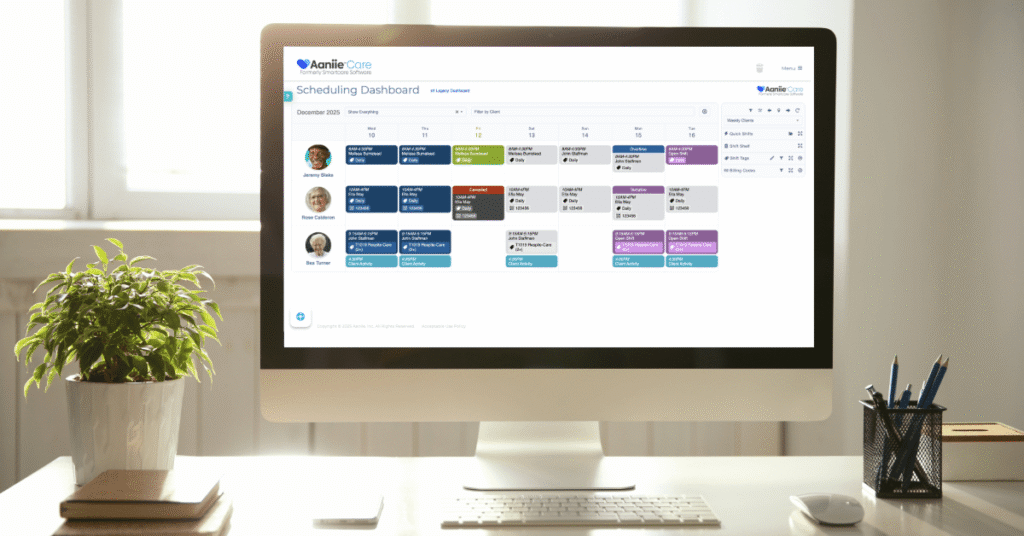
Scheduling sits at the heart of home care operations. It requires balancing caregiver availability, client needs and preferences, geographic considerations, and changing circumstances – often in real time.
Scheduling capabilities that operate in sync with caregiver records, care plans, and visit verification within the same platform yield a much clearer outlook of care delivery. For instance, a truly embedded scheduling solution enables:
- Smarter, more intelligent caregiver-to-client matching
- Real-time updates and communication
- Electronic Visit Verification (EVV) for accurate visit tracking
- Clear visibility into staff availability and client schedules
This visibility helps agencies coordinate care more proactively.
Instead of reacting to scheduling challenges as they arise, teams can anticipate needs, make informed adjustments, and maintain a smoother experience for everyone involved.
Touchpoint 3: Care delivery & documentation
Once care begins, accurate and consistent documentation is essential. Caregivers must be able to record visit notes, confirm completed tasks, and communicate important updates to the wider care team.
Mobile caregiver tools (such as a dedicated Caregiver App) make this process simple and efficient. Staff can document services in real time, verify care tasks, and ensure that records remain accurate and up to date.
When documentation exists alongside scheduling and care plans, agencies benefit from:
- Stronger compliance and recordkeeping
- Reduced administrative paperwork
- Clear communication between caregivers and administrators
- Improved audit readiness
Moreover, centralized documentation also helps agencies maintain a consistent view of client care over time. Care teams can easily reference plans, track updates, and ensure that services remain aligned with client needs, even as those needs may evolve.
Touchpoint 4: Payroll & billing

Payroll and billing may typically represent the final stages of the care delivery cycle, but they are closely connected to everything that comes before them.
When verified visits flow directly into payroll processing and billing workflows, agencies can manage financial operations with greater clarity and efficiency. With a unified platform, for example, agencies can:
- Automatically translate verified visits into payroll hours
- Generate invoices tied directly to delivered services
- Reduce discrepancies between scheduling, documentation, and billing
- Track private-pay services with greater accuracy
These capabilities support faster payroll cycles, fewer billing questions or confusion, and more predictable cash flow. Just as importantly, they reduce the administrative effort required to reconcile information between disconnected systems.
Teams can review verified visits, generate payroll hours, and produce invoices from the same dataset – reducing what used to take a day or more of administrative effort into a task that can be completed in 30 minutes or less.
The executive advantage: A view of the entire operation
For agency leaders, operational clarity is one of the greatest advantages of a unified software platform. When everything operates from the same system, leaders gain access to reporting tools that bring together insights from across the organization.
This level of visibility allows agencies to track important operational indicators such as caregiver utilization, client retention trends, referral performance, revenue patterns, and broader service delivery metrics. Instead of piecing together reports from multiple sources, leaders can view performance in one place and understand how different parts of the operation connect.
They gain immediate access to the information they need: whether that’s reviewing performance trends, preparing for growth, or ensuring that the agency’s daily operations remain running smoothly.
In this way, a cleaner, more comprehensive view of the business equips leaders to better identify opportunities, respond to trends, and plan for the future. These insights support more confident decision-making and provide a stronger foundation for sustainable agency growth.
“All-in-one” is about simplicity and visibility

As they grow, agencies might build their technology stack by combining several specialized tools. While each may serve a specific function, every additional system introduces another potential subscription (and the costs associated with that), another login, and another workflow to keep track of.
At first glance, individual solutions can appear cost-effective. But in practical terms, as agencies layer scheduling platforms, documentation tools, EVV systems, payroll integrations, and billing software, the combined cost of maintaining multiple subscriptions can grow quickly. And beyond the financial cost, managing several systems only adds complexity to daily operations.
There is an alternative way of doing things.
A truly all-in-one platform like Aaniie Care offers a different approach by bringing essential operational functions together into a single ecosystem. This simplifies workflows, reduces the need for multiple software subscriptions, and eliminates the time teams spend switching between tools. It also helps maintain consistency across the organization, since intake, scheduling, documentation, payroll, and billing all operate within the same system.
The result is a technology foundation that supports both operational simplicity and financial transparency, allowing agencies to focus more of their time and energy on delivering high-quality care.
Take your care agency from complexity to clarity
Ultimately, every stage of the home care journey matters: from the first intake conversation through to the final invoice, including every touchpoint along the way.
Agencies that manage intake, scheduling, care delivery, payroll, and billing within a unified platform gain greater confidence in their operations. Information flows naturally, processes dovetail, and teams spend less time switching between different systems.
Most importantly, agencies achieve the freedom to focus on what matters most: delivering exceptional care.
Experience first-hand how a unified platform can simplify your workflows, reduce administrative overhead, and help your team focus on delivering exceptional care.
Request a free demo or talk to our team today