
What Are the 10 Best Home Care Software Providers in 2026? Ranking & Analysis
Published on February 12, 2026 by Scott Zielski
Home care agencies are operating in a moment of sustained pressure.
Rising labor costs, inflationary strain, and tighter regulatory oversight are creating financial challenges. At the same time, families are more cost-sensitive and quality-conscious than ever, expecting dependable care from familiar, well-trained caregivers without sudden price increases.
In this environment, technology can become a strategic lever – directly impacting operations and experiences. The right home care software helps reduce administrative friction, streamline scheduling, support compliance, and improve workforce engagement, all while helping you maintain affordable, high-quality care for clients.
So, what does “best” mean in 2026?
The top home care software platforms aren’t just feature-rich. They solve the industry’s most pressing challenges: finding, hiring, engaging, and retaining caregivers, all while allowing agency leadership to focus on growing the business and improving client outcomes.
What should you look for in home care software?
Choosing the right home care software means selecting a solution that supports your operational reality, reduces hidden costs, and helps you build a stable, satisfied workforce. The “best” software empowers your team, improves client experiences, and scales with your growth.
Before committing to a platform, home care agencies should consider:
- How automated is scheduling? Can the system align caregiver skills, availability, and client preferences automatically?
- Does it simplify or complicate EVV compliance? Is electronic visit verification integrated?
- Is billing embedded or patched together? Can you manage payroll, invoicing, and client payments in one system?
- Does it actively improve caregiver retention? Are there tools to monitor, engage, reward, and support your workforce?
- Can you see data in real time? Does the platform provide actionable insights at a glance?
- Will it scale with you? Can the software handle more clients, caregivers, and locations without requiring new systems or complicated integrations?
- Is it a complete solution? Or a patched-together network of separate integrations? True efficiency comes from unified systems.
- How will the company support you when you have a question? Does the provider offer responsive, expert guidance?
Asking these questions helps ensure your software sets you up for sustained growth and stronger client/caregiver satisfaction.
The 10 Best Home Care Software Providers in 2026
#1: Aaniie Care
Overview
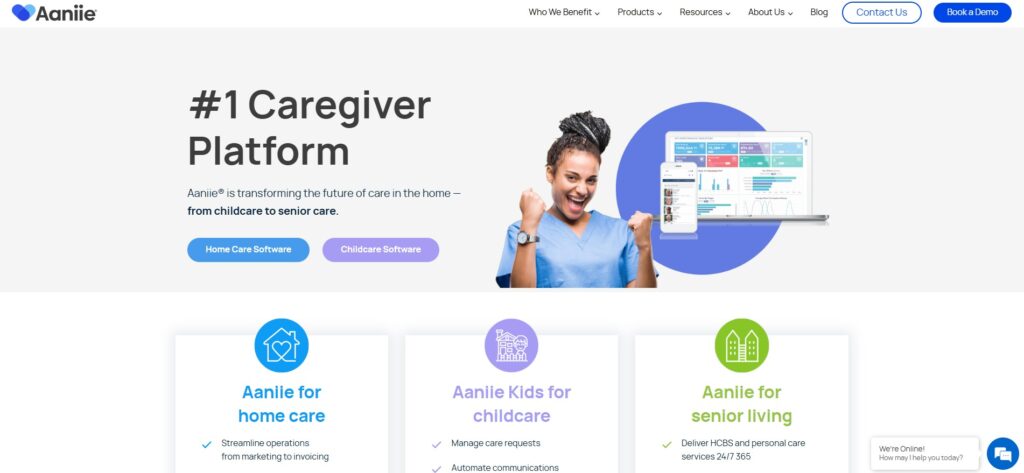
Aaniie Care (formerly Smartcare Software) is a purpose-built home care software designed to help agencies navigate today’s most pressing operational, financial, and workforce challenges. It unifies scheduling, care delivery, billing, EVV, and caregiver retention into a single platform. By reducing administrative burden, providing real-time insights, and improving caregiver and client engagement, it allows agencies to focus on delivering high-quality, affordable care. Agencies also benefit from dedicated, U.S.-based Customer Success support, guiding setup, training, and ongoing optimization – so teams can get the most from the platform, right from day one.
Best for
Aaniie Care is ideal for private-duty home care agencies that are growing rapidly, managing multiple locations, or operating in a competitive market where caregiver satisfaction, client retention, and operational efficiency are critical. It is particularly well-suited to agencies aiming to consolidate multiple systems or workflows, and ideal for agencies seeking hands-on, human, responsive support that adapts as the organization grows.
What it is
Aaniie Care is a fully unified home care platform. Key functionalities include:
- Automated scheduling
- Client/caregiver matching
- EVV compliance
- Embedded billing and payroll
- Recruitment & Applicant Tracking System
- Marketing & CRM tools
- Caregiver engagement and retention
- A mobile caregiver app
- Real-time analytics
- Enterprise-level KPI dashboards
- Satisfaction tracking
- Embedded payment processing
- Personalized implementation & training
- Step-by-step onboarding
- Role-specific workshops
- Ongoing guidance & support
Biggest strengths
- A truly unified platform. No patchwork integrations – everything operates in one place.
- People-first design – “humans caring for humans supported by advanced technology”. Includes tools to retain, engage, and manage caregivers.
- Scalable architecture. Works whether you’re a single-location agency or a multi-region operator.
- Proactive decisions. Real-time visibility enables you to spot trends and prevent disruptions before they escalate.
- A dedicated Customer Success team. Providing hands-on support and expert guidance right from day one.
- Tailored training. Resources available for every role, ensuring smooth adoption and confidence across the organization.
- Responsive, ongoing support. Helps the platform scale seamlessly with your agency’s growth.
How it’s different
Unlike legacy systems or software built for broader healthcare sectors, Aaniie Care was designed specifically for home care agencies.
Aaniie Care balances operational efficiency with workforce engagement and client experience. Its intuitive interface and holistic approach mean agencies can spend less time on admin and more time on quality care. Unlike other platforms, Aaniie combines its unified technology with high-touch, personalized support, acting as a true partner in helping agencies implement, optimize, and evolve their workflows.
Pricing notes
Aaniie offers flexible pricing, with the All-inclusive Pro package (starting at $13 per client per month) a popular selection. Further details can be found on the Pricing page, or get in touch today to discuss your specific needs.
Is it for you?
Yes, if your agency is seeking a complete, modern solution that tackles today’s operational pressures head-on, Aaniie is the top choice.
Aaniie is also ideal for agencies that value a supportive partner: the responsive, U.S.-based team works closely with your staff to resolve issues quickly and ensure ongoing operational success.
Aaniie offers a complete solution to:
- Reduce turnover and improve caregiver satisfaction
- Streamline scheduling, billing, and compliance in a single ecosystem
- Gain actionable insights through real-time data
- Scale operations without unnecessary complexity
In short – for agencies aiming to future-proof their operations and keep quality care accessible for clients – Aaniie is the home care software of choice.
Why Aaniie wins: At a glance
| Dimension | Aaniie Care | Legacy or Alternative Systems |
|---|---|---|
| System architecture | Truly unified platform with a single data environment across scheduling, EVV, billing, payroll, and engagement | Multiple modules and third-party tools connected through integrations |
| Data consistency | One source of truth across operational and financial workflows | Data often synced between systems, increasing reconciliation effort |
| Workflows | End-to-end workflows designed to run inside one ecosystem | Workflows may frequently cross system boundaries |
| Caregiver & client experiences | Experience and retention features built directly into the core platform | Engagement tools often added through separate modules or apps |
| Decision making | Real-time dashboards and operational visibility built into daily workflows | Reporting commonly run after the fact across separate datasets |
| Configuration & growth | Designed to scale without rebuilding your tech stack | Growth often requires adding or re-configuring additional tools |
| Support model | Dedicated, home-care-focused success and support partnership | Likely to be less responsive, less personalized, and more generic |
#2: AxisCare
Overview
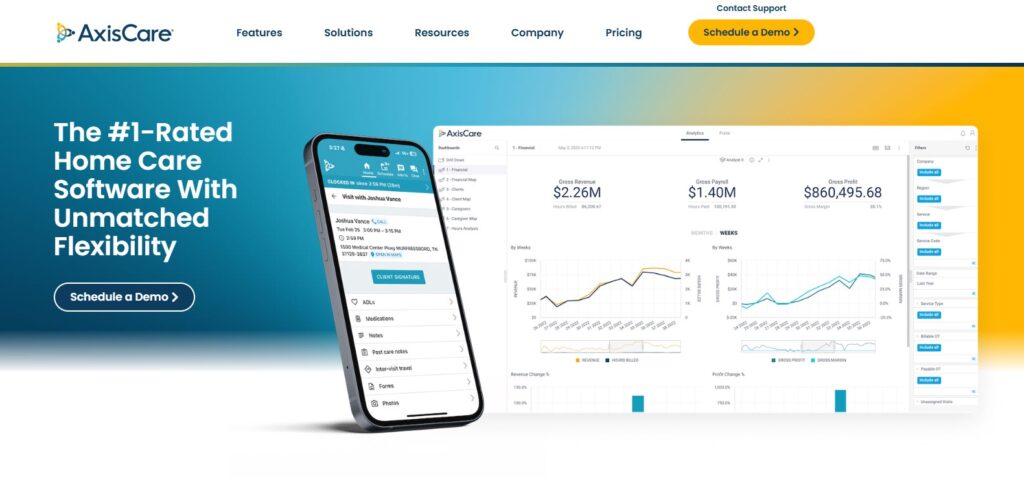
AxisCare is an established home care management platform in the U.S., recognized for strong scheduling, flexible care plans, and a client-centered portal, and widely used by private‑duty agencies for operational clarity and caregiver coordination.
Best for
Agencies that want highly configurable scheduling and reliable caregiver engagement tools without technical complexity.
What it is
AxisCare offers scheduling, billing, an app, documentation, a client portal, and reporting under one roof. The emphasis is on efficiency and usability.
Biggest strengths
- Intuitive scheduling with drag‑and‑drop capabilities
- A mobile app and client communication tools
- CRM and marketing modules
- Strong user satisfaction ratings
Potential drawbacks & limitations
- Limited built-in billing and payroll capabilities. Some agencies will require third-party integrations
- Reporting is functional, but lacks advanced analytics for multi-location agencies
- Support is primarily reactive. Less dedicated attention during onboarding or workflow optimization
How it’s different
AxisCare strikes a balance between simplicity and capability: it covers core operational needs with less training overhead than some other enterprise platforms, although it isn’t as deep in some functionalities or analytics.
Pricing notes
AxisCare pricing is based on agency size and modules selected. Packages are built for small, medium, large, and enterprise agencies.
Is it for you?
Yes, if you need robust scheduling and caregiver coordination with a platform that’s easy to adopt.
No, if you don’t want to purchase additional third-party solutions to make a complete platform, or if you expect proactive, high-touch customer support during setup and ongoing operations.
#3: WellSky Personal Care
Overview
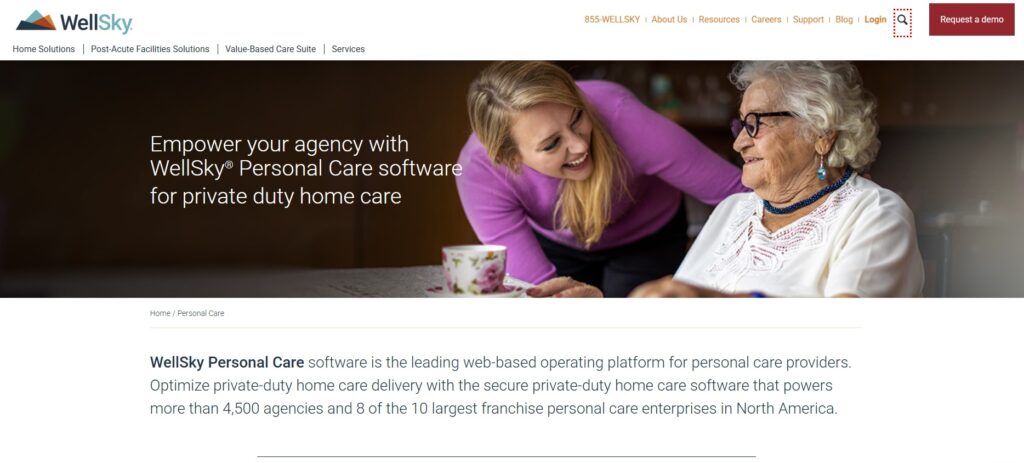
WellSky (formerly ClearCare) Personal Care is a comprehensive agency management system with deep data tools and workflow automation. It’s popular among mid‑to‑large agencies that need strong reporting alongside core operations.
Best for
Growing agencies with multiple locations, complex compliance needs, or those that value analytical insights and operational standardization.
What it is
WellSky combines scheduling, visit tracking, billing, payroll, caregiver mobile app, and enterprise dashboards. It’s designed to provide operational visibility and compliance support across large organizations.
Biggest strengths
- Enterprise‑grade reporting and analytics
- Reliable EVV integration and compliance support
- Scalable architecture for multi‑location agencies
- Workflow automation for routine tasks
Potential drawbacks & limitations
- Steeper learning curve for smaller or non-technical teams
- Limited caregiver engagement tools. Retention features are minimal.
- Support is functional but may be slower for more nuanced or multi-site implementations
How it’s different
WellSky excels in data visibility and organizational governance. It’s less about experiences (such as caregiver retention through gamification), and more about operational command centers and compliance management.
Pricing notes
The exact costs of WellSky Personal Care are not openly available. It offers a subscription-based, tiered pricing model, depending on the number of active clients and caregivers.
Is it for you?
Yes, if you need strong reporting, compliance, and analytics across multiple teams or branches.
No, if you are a smaller agency without a dedicated team to manage workflows. Also less ideal if workforce engagement and caregiver retention tools are a priority.
#4: AlayaCare
Overview
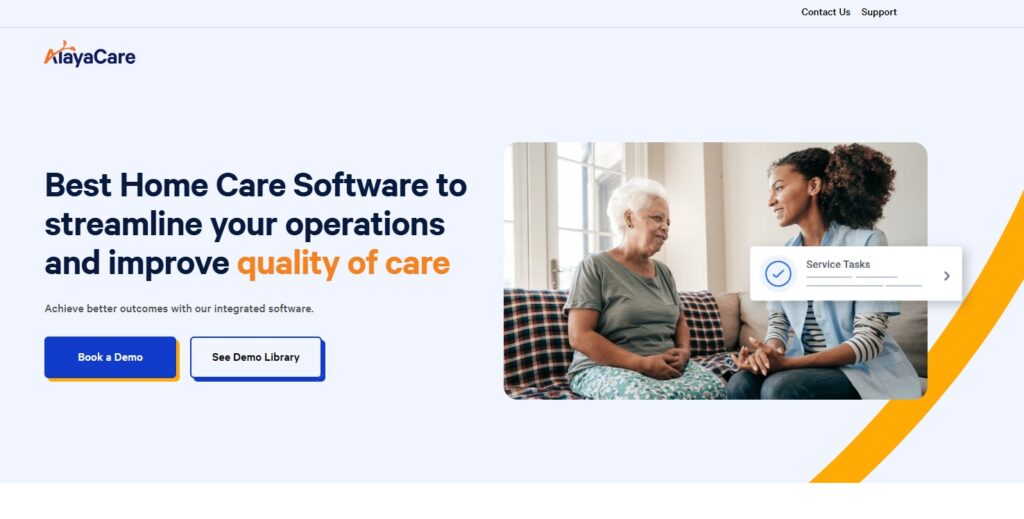
AlayaCare is a cloud‑native platform bridging home care and home health needs. It has grown quickly in recent years thanks to rich automation, scheduling, and data‑driven decision tools.
Best for
Mid‑to‑large agencies (including those with clinical workflows) that need intelligent automation and strong mobile functionality.
What it is
AlayaCare includes scheduling, EVV, billing, clinical documentation, mobile tools, and data dashboards. Its platform is built for both non‑medical and clinical home care contexts.
Biggest strengths
- Scheduling with predictive capabilities
- A mobile app for caregivers and clinicians
- Strong and secure API integrations
- Analytics and business intelligence
Potential drawbacks & limitations
- Designed specifically with medical care in mind. Some non-clinical agencies may find features excessive
- Advanced automation and dashboards likely require additional training
- Limited support responsiveness compared to others
How it’s different
AlayaCare is positioned as a data‑forward system. It uses automation to reduce manual work and supports both clinical and non‑clinical workflows – making it distinct from tools focused solely on non‑medical care.
Pricing notes
AlayaCare offers quotes upon request, according to tiered pricing based on modules and functionality.
Is it for you?
Yes, if you want a platform that scales into clinical care and automation.
No if hands-on, proactive support is important to you. Equally, if your agency focuses on private-duty, non-clinical home care, AlayaCare may not be for you.
#5: CareSmartz360
Overview
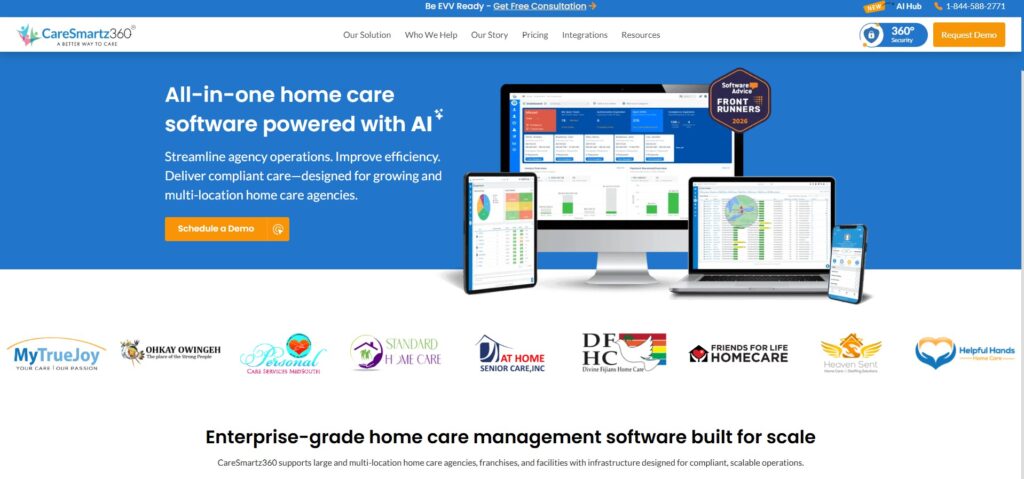
CareSmartz360 is an AI-powered, enterprise-grade home care management system combining scheduling, mobile, billing, and compliance tools. It’s known for good coverage of core needs and strong support infrastructure.
Best for
Non-medical home care agencies, franchises, and staffing providers.
What it is
An integrated home care system with scheduling, EVV, billing and payroll, caregiver engagement, document management, and reporting capabilities.
Biggest strengths
- Centralized system with mobile support
- Modular deployment
- Good adoption and onboarding frameworks
- Solid performance for daily operations
Potential drawbacks & limitations
- Modular design can create a fragmented experience
- Limited built-in analytics and reporting
- Support quality may vary depending on subscription level
How it’s different
CareSmartz360 emphasizes modularity – you can start with essentials and add layers as needed. This makes it friendly for agencies that want growth in stages.
Pricing notes
Industry-aligned pricing with modular feature add‑ons. Offers flexible packages ranging from growing, large, enterprise, and franchisor agencies.
Is it for you?
Yes, if you want an easy‑to‑scale solution that fits standard home care operations without heavy upfront complexity.
No, if you want an out-of-the-box, fully integrated system for payroll, billing, and reporting, or if you’re seeking consistent, high-touch support.
#6: MatrixCare Home Care
Overview
MatrixCare Home Care is part of the broader MatrixCare ecosystem, known for interoperability and strong documentation. It’s often used by agencies that work across non‑medical, skilled care, and wider health ecosystems.
Best for
Larger agencies, or those that blend non‑medical care with clinical services and need cross‑platform interoperability.
What it is
An enterprise home care platform that includes scheduling, visit management, billing, EVV, clinical documentation, and integrations.
Biggest strengths
- Deep clinical and administrative integration
- Interoperability with larger EHR and care networks
- Strong compliance and audit support
- Enterprise‑grade scalability
Potential drawbacks & limitations
- Higher cost may be prohibitive
- Complex setup and integration process. Requires IT resources
- Less focused on caregiver engagement and workforce management
How it’s different
MatrixCare Home Care’s strength is enterprise-level interoperability. It’s part of a larger care continuum.
Pricing notes
Enterprise‑oriented pricing, starting from $2,000/mo with custom layering. Typically, a higher investment.
Is it for you?
Yes, if you’re a large agency needing clinical depth and cross‑system interoperability.
No, if you are a small or medium-sized agency without IT support. No. if caregiver retention and operational simplicity matter more to you than clinical depth.
#7: HHAeXchange/Generations
Overview
HHAeXchange (often positioned with Generations) is a home care platform with strong Medicaid EVV and compliance tools, often used where state reporting and payer integrations are key.
Best for
Agencies with a significant Medicaid payer footprint or heavy state compliance requirements.
What it is
A compliance‑centric management system offering EVV, scheduling, billing, and workforce management with a strong state reporting orientation.
Biggest strengths
- Excellent Medicaid and EVV compliance support
- Workforce management tuned to payer requirements
- Integration with state systems in multiple markets
Potential drawbacks & limitations
- Primarily built for Medicaid/state compliance
- Limited functionality for private-pay operations
- Interface can feel compliance-heavy rather than user-friendly
- Support is focused on state reporting. Less emphasis on proactive workflow optimization
How it’s different
HHAeXchange is about compliance and payer integration first. Operational tools are robust, but built around that compliance core.
Pricing notes
Capterra reports prices starting from $375 per user, per month. HHAeXchange pricing may be considered premium, due to compliance value and integration depth.
Is it for you?
Yes, if Medicaid/state EVV and payer requirements dominate your operational profile. Less ideal if your focus is private pay or retention.
No, if you want a platform designed for overall operational efficiency, (not just compliance). Additionally, not ideal if your agency relies mainly on private-pay clients.
#8: CareTime
Overview
CareTime is a more streamlined home care solution focused on core operations – scheduling, documentation, billing, EVV – without additional complexities.
Best for
Small agencies or startups that want straightforward tools covering daily business needs.
What it is
A cloud‑based management platform with scheduling, visit documentation, billing, EVV, and reporting.
Biggest strengths
- Simplicity and ease of use
- Cost‑competitive for smaller agencies
- Covers core home care workflows
Potential drawbacks & limitations
- Minimal analytics and reporting
- Limited forecasting capabilities
- Few features beyond core scheduling and billing
- Growth-oriented tools are limited
- Support infrastructure is smaller and less proactive
How it’s different
CareTime is functional and accessible. It covers essentials well, but doesn’t extend as deeply into analytics, retention tools, or enterprise automation.
Pricing notes
Starting from $170 per user, per month (Capterra). Generally, mid‑to‑low pricing with predictable subscriptions. CareTime claims to have “the most competitive pricing in the industry.”
Is it for you?
Yes, if you want a solid, straightforward operational platform without enterprise-level complexity.
No, if your agency plans to scale quickly or needs multi-location reporting. Also, a no if you require caregiver engagement or workflow optimisation support.
#9: Axxess
Overview
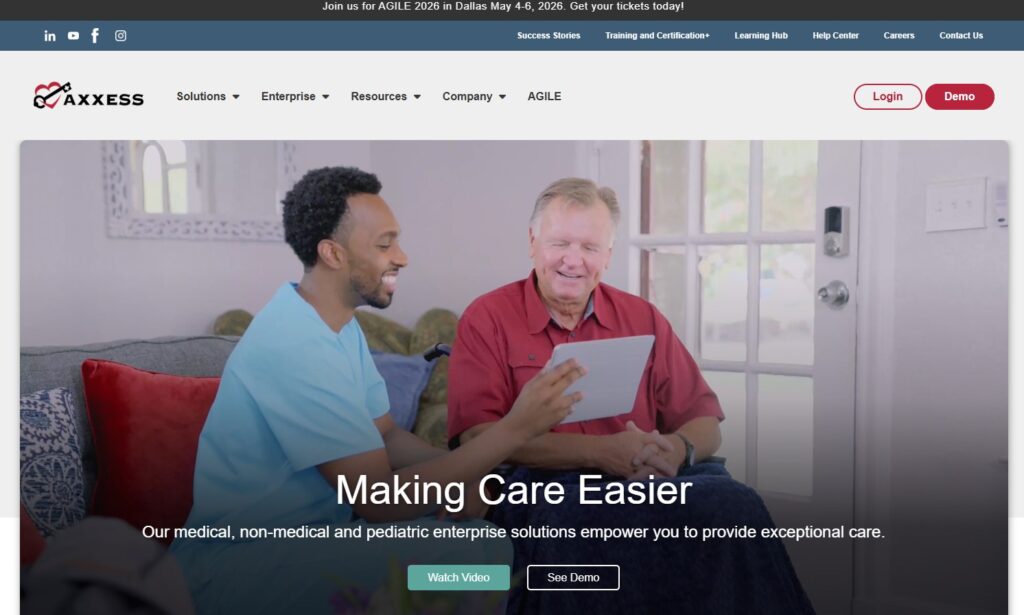
Axxess is one of the largest home health and home care software providers, known for broad feature sets, compliance coverage, and deep partnerships with payers and regulators.
Best for
Agencies that want a comprehensive, established system with highly scalable features.
What it is
A full management platform including scheduling, clinical documentation, billing, EVV, compliance, and mobile caregiver tools.
Biggest strengths
- Large install base and strong industry adoption
- Flexibility across service types (non‑medical, skilled, hospice)
- Compliance and payer support
Potential drawbacks & limitations
- Broad, one-size-fits-all approach can lead to complexity and longer onboarding times
- Pricing is higher, especially for smaller agencies that don’t use all modules
- Support may be stretched across large client base, limiting responsiveness
How it’s different
Axxess aims to be a one‑size-fits-all solution for virtually every care model – which gives it breadth, but can introduce configuration complexity.
Pricing notes
Enterprise pricing with packaged/customizable tiers. Axxess pricing tends to be higher due to feature breadth.
Is it for you?
Yes, if you want a broad, highly configurable platform suitable for mixed service models.
No, if you want a simpler, more streamlined solution, or if you’re looking for hands-on, personalized support for adoption and scaling.
#10: CareVoyant
Overview
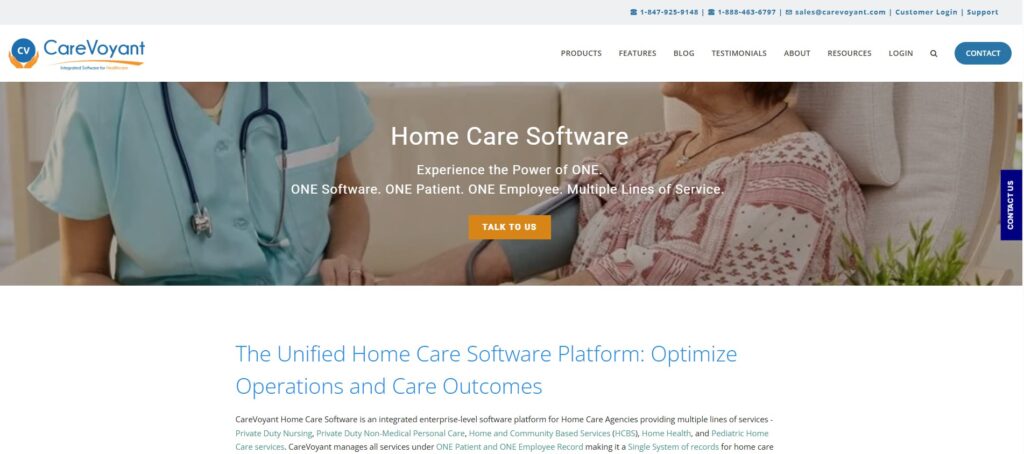
CareVoyant is an integrated home care software solution, featuring a centralized data platform for clinical and operational workflows.
Best for
Agencies that want a single system of records across clinical, operational, and billing functions.
What it is
An enterprise‑scale platform that integrates scheduling, intake, clinical documentation, EVV, billing, and family/staff portals.
Biggest strengths
- Centralized data model
- Strong AR and billing support
- Family and caregiver portals
Potential drawbacks & limitations
- Enterprise-oriented. Smaller agencies may find setup and customization overwhelming
- Less focus on caregiver engagement and workforce retention
- Support may be slower and less personalized
How it’s different
CareVoyant’s stand‑out feature is its centralized ecosystem, integrating all home-based services, including HCBS and home health.
Pricing notes
Generally positioned for larger agencies with customized pricing. Quotes available via a consultation.
Is it for you?
Yes, if you prioritize consistent record-keeping and full integration over modular or piecemeal setups.
No, if you are a small to mid-sized agency seeking a fully supported solution. No if caregiver engagement and integrated financial workflows are central to your operations.
Choosing the right platform for your home care agency
The providers that stand out in 2026 are those that go beyond core operations and administration, and are actively designed around the realities agencies face now – such as workforce stability, financial visibility, and long-term scalability. It’s primarily for this reason that Aaniie earned the top position in this ranking.
Ultimately, selecting the right home care software is about finding the solution that fits your agency’s operational reality: the one that helps you manage costs, retain caregivers, streamline operations, and deliver the kind of high-quality care your clients expect.
Some agencies may prioritize automation to manage complex schedules, while others look for real-time compliance visibility – or, increasingly, agencies are looking for tools that directly support caregiver engagement and retention. Platforms like Aaniie are purpose-built to meet these modern challenges, letting you focus on what matters most: delivering exceptional care while keeping your agency financially sustainable.
In short, when evaluating “the best” software available in 2026, ask yourself: what problem do we need to solve? How will this platform scale with my agency? Does it genuinely reduce administrative friction, or will it just shift complexity elsewhere? The right choice is the one that fits your reality.