
Expanding Into Private Duty Nursing Without Expanding Your Tech Stack: A Guide for Home Care Agencies
Published on May 27, 2026 by Anna from Aaniie
Non-medical home care agencies across the US continue to face growing pressure from multiple angles. From the growing demand for aging-in-place services and ongoing caregiver shortages to complex regulatory updates, increasing costs, and declining profit margins, it’s harder than ever for providers to rely solely on traditional personal care services for long-term growth.
As a result, many agencies are beginning to explore new ways to diversify services, strengthen revenue streams, and future-proof their business models. For some, that means partnering with organizations like PACE, building more flexible care programs, or adding higher-acuity service lines – like Private Duty Nursing (PDN) – to allow them to care for seniors across a broader range of needs over time.
In this article, we’ll be exploring:
- Why more home care agencies are expanding into Private Duty Nursing.
- Key factors providers should consider before deciding whether expanding into PDN is the right fit for them.
- How agencies can scale into higher-acuity care services without adding unnecessary operational and technology complexity.
Why more home care agencies are expanding into Private Duty Nursing
For many non-medical home care providers, expanding into Private Duty Nursing (PDN) is becoming an increasingly attractive option to strengthen long-term business stability and growth.
While every agency’s growth path looks different, a model that blends both non-medical and PDN care services can deliver several key strategic advantages.
Key advantages include:
Increased revenue opportunities
Adding PDN services allows agencies to increase both service revenue and overall business value.
In addition to opening the door to new billable service lines, PDN typically commands higher-value fees than traditional non-medical care alone, due to the increased level of clinical support it delivers.
For providers looking to grow beyond personal care services alone, Private Duty Nursing can offer a valuable opportunity to unlock long-term revenue potential.
Diversified payer sources
Many non-medical home care businesses rely heavily on private-pay clients, which can create financial vulnerability during economic uncertainty or shifts in consumer spending.
Expanding into Private Duty Nursing can open the door to additional payer sources, including Medicaid waiver programs, long-term care insurance, VA benefits, and other reimbursement pathways – reducing reliance on a single revenue source.
A more diversified payer mix can help agencies build greater financial resilience while broadening access to care for more families.
Improved client retention

One of the biggest challenges providers face is losing senior clients as their care needs become more complex. By offering clinical care alongside personal care services, agencies can continue supporting clients as their health conditions change without requiring an immediate transition to another provider or a higher-level care facility.
This continuity can make a major difference for both clients and their families. Instead of starting over with an unfamiliar care team, seniors can maintain relationships with the caregivers they already know and trust, while receiving additional nursing services as needed. This supports client satisfaction, reduces disruption during vulnerable periods, and improves aging-in-place outcomes.
Whether a client requires ongoing skilled nursing or temporary post-hospitalization services (such as wound care, injections, or medication management), integrated care agencies can deliver more seamless, coordinated care, which enhances long-term client retention.
Stronger competitive differentiation
As competition in the home care industry continues to grow, many providers are looking for ways to stand out in increasingly crowded markets.
Offering both non-medical and clinical care services positions agencies as more comprehensive care providers, capable of supporting a wider range of senior needs over a longer period.
This gives operators the opportunity to establish themselves as a full-continuum care provider within their communities, and build stronger relationships with referral partners – including hospital discharge planners, case managers, and physicians.
Enhanced recruitment, retention, and workforce stability

Building a ‘hybrid’ care model creates new professional development opportunities for caregivers and clinical staff alike, helping to encourage long-term employee growth and loyalty.
Employing a mix of RNs, LPNs/LVNs, and CNAs/HHAs naturally creates internal career pathways, with clear opportunities for caregiver career advancement, upskilling, and expanded clinical collaboration.
In a highly competitive labor market, this can help agencies significantly enhance their staff recruitment and retention efforts – and build greater workforce stability over time.
While the benefits of expanding into Private Duty Nursing are substantial, it’s important that agencies carefully consider the various challenges that come with adding clinical care services – including compliance, staffing, care planning, and financial management – in order to navigate them successfully.
Manage private duty nursing and home care from one connected platform with Aaniie Care.
Key factors home care agencies should consider before expanding into Private Duty Nursing
One of the appeals of expanding into Private Duty Nursing is that it allows agencies to leverage much of their existing operational foundation rather than building a new one entirely from scratch.
However, adding higher-level clinical care does introduce new operational challenges that providers need to evaluate before moving forward – to be sure their existing systems, processes, and infrastructure can effectively support clinical care delivery at scale.
Key considerations include:
1. Licensing and compliance
Expanding into Private Duty Nursing means navigating a more complex regulatory environment than is typically needed for traditional non-medical home care.
Requirements can vary significantly by state and may include specific licensing obligations, clinical oversight standards, supervision requirements, and stricter HIPAA compliance expectations.
Providers need to be sure they have reliable processes to handle more advanced clinical documentation workflows and maintain audit-ready records – particularly when working with Medicaid waiver programs, long-term care insurance providers, or other third-party payers.
As agencies expand their PDN services, having systems in place to facilitate compliant documentation, customizable workflows, and centralized digital record management will become increasingly important.
2. Staffing and workforce management
Like much of the healthcare industry, Private Duty Nursing providers continue to face staffing shortages and increased competition for qualified clinical staff. For home care agencies expanding into PDN, recruiting and retaining experienced RNs and LPNs/LVNs can become a significant operational priority – especially when competing with hospitals, other agencies, and skilled nursing facilities.
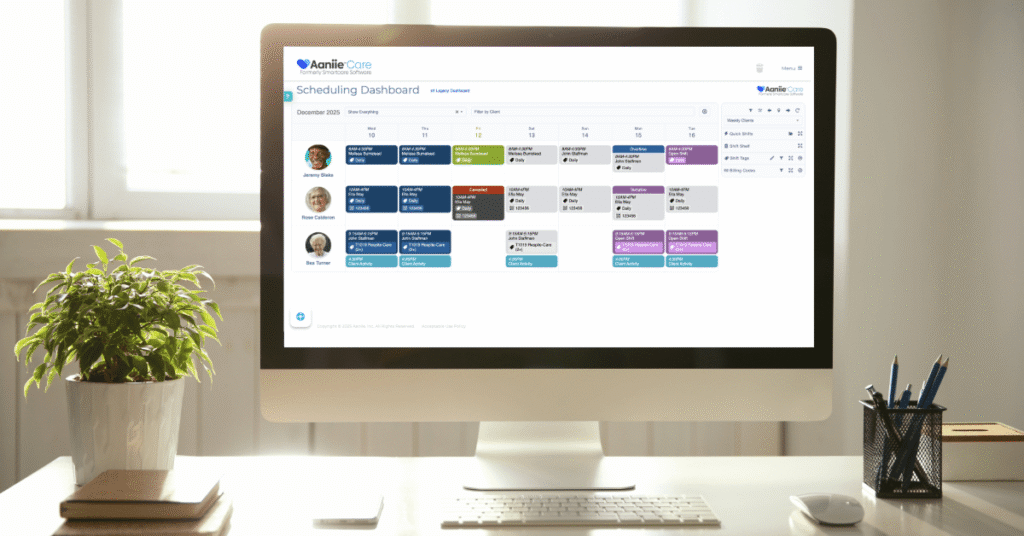
In addition, providers need effective ways to manage scheduling and coverage across both non-medical and clinical care services, while maintaining visibility across teams and locations.
Managing nursing licenses, certifications, training requirements, and clinical supervision processes can also become more demanding as agencies expand their staffing structure and service offerings.
As services grow and include more clinically advanced care, having the right tools in place to streamline staff scheduling, communication, credential tracking, training, and oversight will become essential to creating an organized and supportive working environment. This not only improves operational efficiency but also strengthens long-term retention and workforce stability.
3. Care planning and coordination
Managing both non-medical and clinical care services often requires a much higher level of coordination across client intake, scheduling, documentation, care planning, and ongoing service delivery.
Without connected processes in place, maintaining continuity of care and ensuring the right information is accessible across teams, clients, and families can quickly become a big challenge.
Providers also need to meet more advanced clinical documentation requirements, including integrated EHR records, medication administration records (MARs), electronic visit verification (EVV), CMS-compliant care plans, and payer-specific documentation standards.
Agencies with basic scheduling tools or disconnected software systems will struggle to provide the level of visibility, compliance support, and operational integration needed to effectively manage Private Duty Nursing services at scale – placing a heavy burden on their admin teams.
Having a centralized system in place – connecting EVV, scheduling, billing, payroll, communication, documentation, and care coordination workflows in real-time – will significantly reduce administrative burden while improving visibility and coordination across the organization.
Agencies that currently operate with an all-in-one care management platform like Aaniie are already in a strong position, helping reduce many of the operational challenges that arise from managing fragmented systems as service lines expand.
4. Financial planning and reimbursement
Moving into higher-acuity care services introduces a different financial structure that non-medical home care agencies need to carefully plan for.
Investment in clinical staffing, training, and service development can increase upfront costs during the early stages of expansion.
At the same time, revenue cycles may become less predictable, with variations in authorization requirements, payment timelines, and reimbursement processes across different payer types – including private pay, Medicaid waivers, VA programs, and other insurance providers. This can place additional administrative pressure on billing processes and short-term cash flow management, potentially delaying revenue collection without the right systems in place.
Before committing to expansion, agencies also need to evaluate whether they’ll have clear visibility into financial performance, labor costs, reimbursement trends, and overall business health to enable informed long-term decision-making. The ability to accurately monitor profitability, identify operational trends, manage financial risk, and maintain sustainable growth becomes increasingly important when adding clinical care services.
It’s important to note that while adding Private Duty Nursing services introduces additional operational and clinical demands, many home care agencies already have much of the foundation needed to successfully pursue expansion. The key challenge lies less in rebuilding operations entirely and more in ensuring systems and workflows are connected and can scale effectively to meet more advanced care delivery requirements.
See how Aaniie Care helps agencies expand services without adding complexity or multiple systems.
How Aaniie helps agencies expand into Private Duty Nursing without expanding their tech stack

While it’s possible for non-medical home care agencies to expand into Private Duty Nursing through partnerships with existing nursing providers or by gradually rolling out clinical services over time, many are looking for a more scalable long-term solution: a single platform that can support both non-medical home care and clinical care delivery within one connected system.
That’s where Aaniie stands apart. Rather than requiring agencies to manage multiple disconnected software systems and subscriptions – or invest in costly home health systems – Aaniie Care brings home care and Private Duty Nursing operations together within one centralized platform.
Agencies can manage HIPAA-compliant clinical documentation, CMS-compliant care plans, EVV, scheduling, staff communication, credential tracking, billing workflows, and real-time operational visibility from a single platform – while also integrating seamlessly with EHR systems like PointClickCare.
With customizable workflows, franchise-level visibility, business intelligence tools, automated billing capabilities, and support for both clinical and non-clinical operations, Aaniie helps providers scale into higher-acuity care services without adding any unnecessary operational complexity.
To find out more, call our team today or book a free, no-obligation demo to see how your home care agency can confidently expand into Private Duty Nursing – without sacrificing operational visibility, efficiency, or the personalized care experience your senior clients depend on.
